

If you’re searching for deeper insight into today’s most compelling gaming innovations, you’re in the right place. This article explores the mechanics, strategies, and immersive systems that are redefining how players experience modern games—from bio-engineered creatures to advanced level-up progression tactics.
We focus on what actually enhances gameplay: smarter core mechanics, meaningful world-building, and systems like dynamic npc design that make virtual environments feel alive and reactive. Whether you’re looking to optimize your strategy, understand emerging design trends, or gain a competitive edge, this guide breaks down what matters and why.
Our analysis draws on extensive gameplay testing, current industry research, and insights from high-level players who actively experiment with evolving mechanics. Instead of surface-level commentary, you’ll get practical, experience-backed explanations that connect theory to real in-game performance.
By the end, you’ll have a clearer understanding of how these systems work—and how to use them to level up smarter and play more strategically.
Beyond Scripts: The Dawn of Truly Dynamic Game Worlds
By combining compelling narratives with immersive design, you can elevate your non-player characters to a level of depth that not only enhances the player’s experience but also complements their journey in skill tree optimization, making every character choice feel like a step toward building the ultimate character – for more details, check out our Skill Tree Optimization: Building the Ultimate Character.
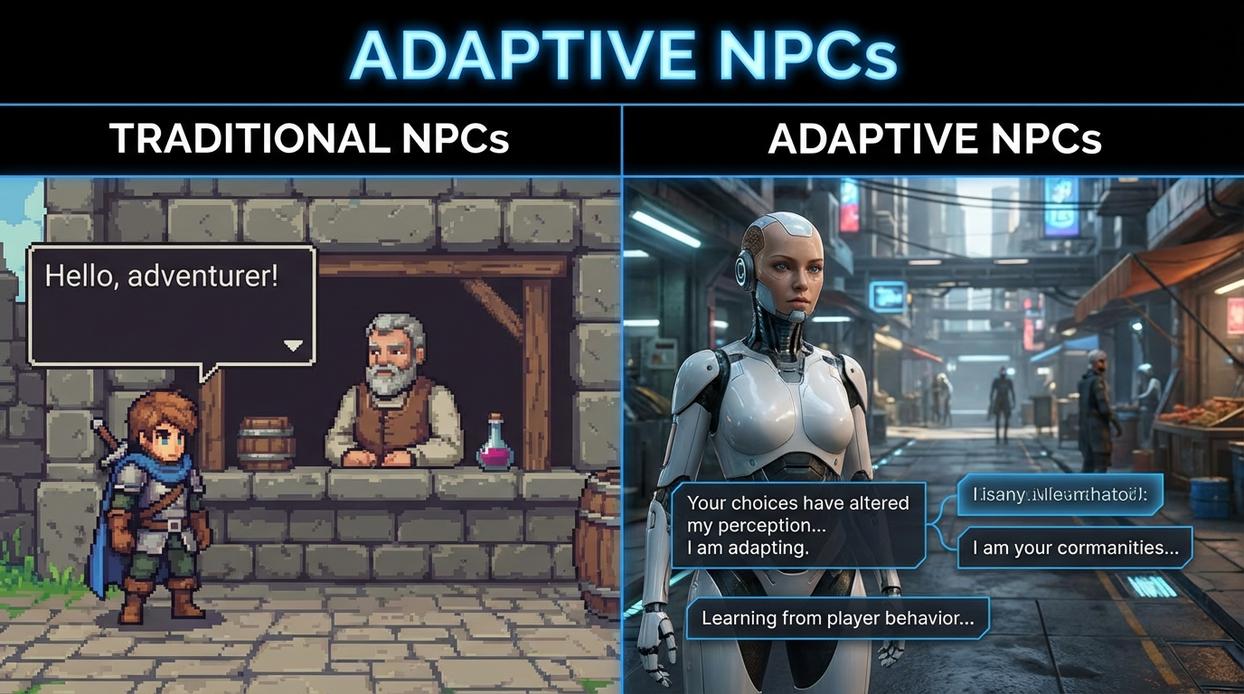
Let’s be honest: nothing shatters immersion faster than an NPC repeating the same three lines like a broken holo-recorder. You save their village, and five minutes later they’re asking you to fetch water again. It’s exhausting. Worse, it makes vast worlds feel strangely small.
So what’s the fix? Instead of rigid scripts, developers can build characters around adaptable internal traits—values like courage, greed, loyalty, or fear—that shift in real time. That’s where dynamic npc design changes everything.
For example, imagine a guard who:
- Becomes braver after surviving battles
- Grows suspicious if theft increases nearby
- Forms alliances based on shared player choices
As a result, every playthrough feels distinct. No more predictable loops—just evolving personalities that react, adapt, and occasionally surprise you (finally).
The Foundation: Architecting Customizable NPC Traits
Have you ever wondered why some NPCs feel alive while others feel like cardboard cutouts waiting for their cue? The difference usually starts with the “character sheet.” And no, we’re not just talking about Health and Mana.
To begin with, think in terms of personality vectors—core behavioral traits that influence decision-making. For example:
- Aggression: likelihood to initiate combat.
- Cowardice: tendency to flee under pressure.
- Curiosity: drive to investigate unknown stimuli.
- Greed: attraction to valuable items or rewards.
- Loyalty: commitment to allies or factions.
Now, how do we implement this without overcomplicating things? A simple dictionary or struct works beautifully. Assign each trait a float value between -1.0 and 1.0. Negative values invert tendencies (a negative Aggression might favor diplomacy), while positive values amplify them. It’s surprisingly powerful (and far more flexible than hardcoded behaviors).
Next, connect traits directly to gameplay systems. A high Greed score could expand an NPC’s detection radius for rare loot. Meanwhile, elevated Cowardice might lower their combat engagement threshold, triggering retreats at 40% health instead of 10%. Sound familiar? That’s how you move from static scripts to dynamic npc design.
Of course, some argue this adds unnecessary complexity. Why not just script archetypes? Fair point—but modular traits let you generate dozens of unique personalities from one base AI, like remixing character builds in an RPG.
Finally, expose these values in an editor interface. Sliders for designers—or even players—enable rapid archetype creation: the reckless scout, the paranoid guard, the gold-obsessed merchant (Smaug would approve). Pro tip: save preset combinations to speed iteration and maintain balance.
Bringing Traits to Life: Designing Adaptive Behaviors
I still remember the first time one of my goblin prototypes surprised me. It was supposed to patrol. Instead, it heard a noise, froze, and ran straight into a trap I’d forgotten to disable. That “bug” turned into my first real lesson in adaptive AI (and yes, I kept the trap).
Choosing Your Logic Engine
When designing creature intelligence, your first decision is the logic engine. Finite State Machines (FSMs) are rule systems where an NPC exists in one state at a time—Idle, Chase, Attack. They’re clean and predictable, perfect for simple wildlife or low-tier enemies.
But once you want layered decisions—hesitation, personality, context—FSMs can become tangled fast.
That’s where Behavior Trees (BTs) shine. A Behavior Tree is a hierarchical decision model that evaluates branches until one succeeds. For dynamic npc design, BTs scale better, stay readable, and allow modular personality tweaks without rewriting everything.
Behavior Trees 101: The Core Components
At their core, BTs use three building blocks:
- Sequences – Execute children in order. If one fails, the whole sequence fails. (Think: “See player → Draw weapon → Attack.”)
- Selectors – Try children until one succeeds. Great for fallback logic.
- Decorators – Gatekeepers that modify or condition a node’s execution.
If art direction shapes visual identity, logic shapes behavioral identity—much like the role of art direction in crafting immersive universes does for worldbuilding.
The “Trait-Checked” Decorator
Here’s the real magic. Create a custom Decorator: CheckTrait(TraitName, Threshold).
Example:
Flee Branch
- Decorator:
CheckTrait: Cowardice > 0.7 - Action: Run to safe point
If the condition fails, the branch never runs. Same tree. Different personality.
Practical Example – The Goblin Scout
Imagine this simplified structure:
Selector
- Sequence: Hear Noise →
CheckTrait: Curiosity > 0.5→ Investigate - Sequence: See Player →
CheckTrait: Aggression > 0.6→ Attack - Sequence: See Player → Wait for Backup
Raise Curiosity? The goblin pokes around every shadow (bad life choice). Lower Aggression? It stalls instead of charging.
You’re not changing logic—you’re tuning temperament. And that’s when NPCs stop feeling scripted and start feeling alive.
From Predictable to Plausible: Emergent gameplay happens when non-player characters act on internal drives instead of prewritten scripts. A “trait” is a measurable personality value—like Greed, Loyalty, or Cowardice—that nudges decisions in real time. In a dynamic npc design model, those values interact, so a greedy mercenary might steal your hard-won kill, while a loyal guard throws herself in front of a dragon’s flame. It feels less like a theme park ride and more like a living world (yes, even when chaos wrecks your plan).
Enhancing Replayability: Because traits are customizable, outcomes shift dramatically. Picture two villages facing the same dragon attack. One is stacked with CURIOUS and BRAVE townsfolk; they investigate, coordinate, and counterattack. The other skews cowardly and selfish; doors slam, supplies vanish, alliances fracture. Same quest, wildly different story.
Synergy with Progression Tactics: “Influence” simply means temporarily modifying a trait through skills or items. A high Charisma check can boost Loyalty; intimidation spikes Cowardice; a rallying speech raises Morale. PRO TIP: stack small, short-term buffs before major encounters to create cascading behavioral shifts. That layered cause-and-effect loop deepens IMMERSION without overwhelming players, because the rules stay transparent and logical. Complexity becomes clarity through smart systemic feedback loops.
Building Worlds That Breathe and React
You now have a clear roadmap for building AI NPCs whose actions stem from personality—not prewritten scripts. That shift alone tackles the core frustration: lifeless, predictable worlds where enemies feel like cardboard cutouts (and players notice fast).
The fix is practical. Separate traits (who the NPC is) from behaviors (what the NPC does). Think of traits as sliders—Aggression, Curiosity, Loyalty. Behaviors then reference those values to decide outcomes. This modular structure powers dynamic npc design without ballooning complexity.
Try this:
- Create an Aggression variable from 0–100.
- If above 70, prioritize attack behaviors.
- If below 30, increase retreat or call-for-help actions.
Pro tip: Log trait-driven decisions during testing to fine-tune balance.
Start small. One variable. One enemy. You’ll be surprised how quickly your world starts to feel alive.
Mastering Immersive Worlds and Smarter Gameplay
You set out to better understand what makes modern games truly immersive—from smarter systems and bio-engineered creatures to progression loops that actually feel rewarding. Now you can see how dynamic npc design, strategic level-up paths, and layered worldbuilding work together to create experiences that players don’t just play—but live in.
The frustration with shallow mechanics and predictable AI is real. Static enemies, lifeless side characters, and grind-heavy progression can break immersion fast. But when core systems are intentional and responsive, every encounter feels meaningful and every upgrade feels earned.
The next move is yours: start applying these insights to your builds, strategies, or world design right now. Focus on smarter AI behavior, deeper creature logic, and progression systems that reward mastery—not repetition.
If you’re serious about elevating your gameplay knowledge and staying ahead of evolving mechanics, dive deeper with Biohunt 2000—trusted by passionate gamers exploring cutting-edge systems and next-level strategies. Don’t settle for surface-level play. Level up your understanding today.
 There is a specific skill involved in explaining something clearly — one that is completely separate from actually knowing the subject. John Colemanastiv has both. They has spent years working with core gaming mechanics and strategies in a hands-on capacity, and an equal amount of time figuring out how to translate that experience into writing that people with different backgrounds can actually absorb and use.
John tends to approach complex subjects — Core Gaming Mechanics and Strategies, Bio-Engineered Game Creatures, Hot Topics in Gaming being good examples — by starting with what the reader already knows, then building outward from there rather than dropping them in the deep end. It sounds like a small thing. In practice it makes a significant difference in whether someone finishes the article or abandons it halfway through. They is also good at knowing when to stop — a surprisingly underrated skill. Some writers bury useful information under so many caveats and qualifications that the point disappears. John knows where the point is and gets there without too many detours.
The practical effect of all this is that people who read John's work tend to come away actually capable of doing something with it. Not just vaguely informed — actually capable. For a writer working in core gaming mechanics and strategies, that is probably the best possible outcome, and it's the standard John holds they's own work to.
There is a specific skill involved in explaining something clearly — one that is completely separate from actually knowing the subject. John Colemanastiv has both. They has spent years working with core gaming mechanics and strategies in a hands-on capacity, and an equal amount of time figuring out how to translate that experience into writing that people with different backgrounds can actually absorb and use.
John tends to approach complex subjects — Core Gaming Mechanics and Strategies, Bio-Engineered Game Creatures, Hot Topics in Gaming being good examples — by starting with what the reader already knows, then building outward from there rather than dropping them in the deep end. It sounds like a small thing. In practice it makes a significant difference in whether someone finishes the article or abandons it halfway through. They is also good at knowing when to stop — a surprisingly underrated skill. Some writers bury useful information under so many caveats and qualifications that the point disappears. John knows where the point is and gets there without too many detours.
The practical effect of all this is that people who read John's work tend to come away actually capable of doing something with it. Not just vaguely informed — actually capable. For a writer working in core gaming mechanics and strategies, that is probably the best possible outcome, and it's the standard John holds they's own work to.