

Gaming evolves fast. New mechanics emerge, metas shift overnight, and immersive worlds grow more complex with every release. If you’re here, you’re likely looking to understand what actually matters—how modern games are built, how their systems connect, and how you can master them more effectively.
This article breaks down the hot topics shaping today’s gaming landscape, from core game loop design to advanced progression systems and bio-engineered creature mechanics. We focus on how these elements function in practice—how they influence player engagement, strategic depth, and long-term replayability.
Our analysis draws on extensive gameplay research, mechanical breakdowns, and comparative system studies across multiple titles and genres. Rather than surface-level commentary, you’ll get clear insights into how mechanics work, why they succeed (or fail), and how to leverage that knowledge to level up your own strategies.
Whether you’re optimizing builds, dissecting world design, or refining tactical approaches, this guide is built to give you a sharper edge.
From Idea to Interaction: The Blueprint for Your Game’s Core
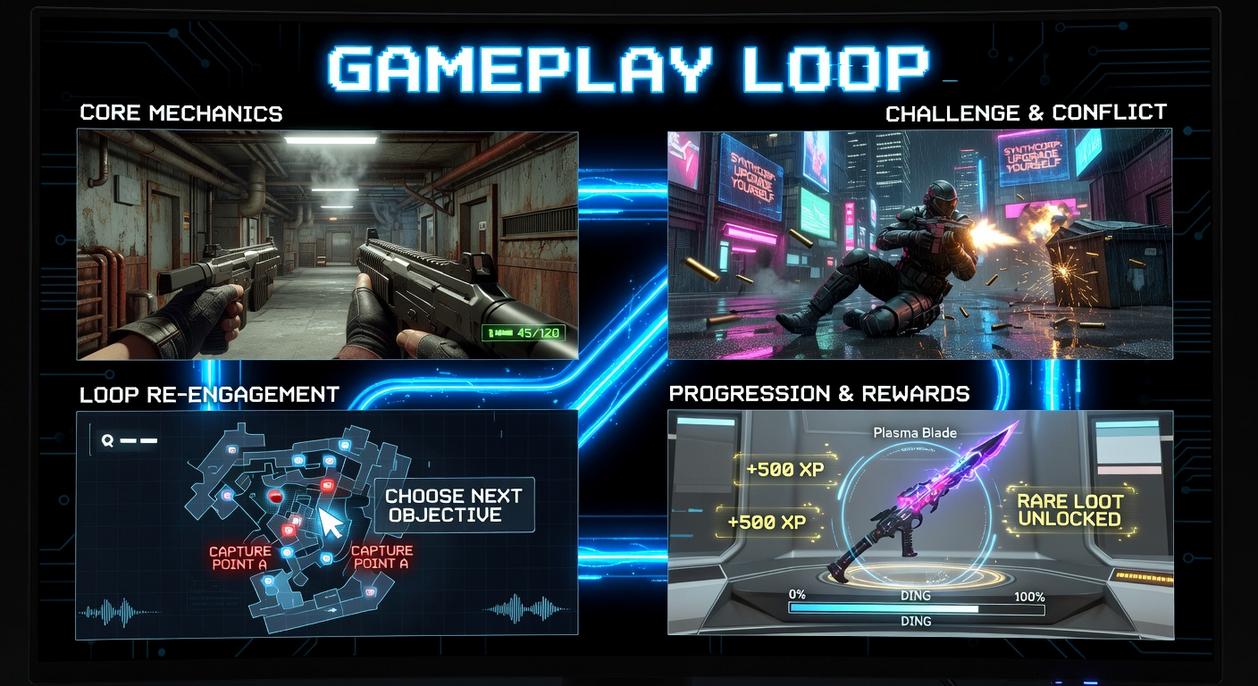
Every hit game starts with a clear, repeatable foundation. Nail your core game loop design and you give players a reason to stay—minutes turn into hours (and hours into “just one more run”). The benefit? Strong retention, organic word-of-mouth, and gameplay that feels instantly rewarding.
A tight loop should be:
- Easy to learn (simple inputs, clear goals)
- Hard to master (skill depth, smart trade-offs)
- Satisfying to repeat (visible progress, meaningful rewards)
Without this structure, even stunning visuals fall flat. With it, you build momentum, mastery, and long-term engagement players genuinely crave.
Defining Your Core Gameplay Loop
If you’ve ever played a game that looked amazing but felt weirdly exhausting after ten minutes, chances are the core loop was broken. And that’s frustrating. No one wants to grind through filler just to find the fun.
What Is a Core Loop?
A core loop is the primary set of actions a player repeats throughout the game. Think: Explore > Hunt Creature > Harvest Biomatter > Upgrade Gear. It’s the heartbeat of your experience. In core game loop design, every major system feeds back into this repeatable cycle.
Here’s the pain point: if even one step feels like busywork (looking at you, endless inventory sorting), players feel it immediately. According to research on player engagement patterns, repetition is satisfying only when it reinforces mastery and progress (Schell, The Art of Game Design).
The 30-Second Fun Test
Strip everything away—no story, no rewards, no flashy UI. Is the main action fun for 30 seconds straight? If combat alone isn’t engaging, no progression system will save it. (Yes, even shiny loot can’t fix boring swings.)
Example – Bio-Hunter Game
- Track a creature.
- Engage using specific abilities.
- Collect a genetic sample.
- Return to base to synthesize a new ability.
Pro tip: Sketch your loop as a simple circle. If any step feels like a chore, redesign it before building anything else.
Building Compelling Progression and Level-Up Systems
Progression is the quiet engine under every great game. It’s the structured sense of growth that keeps players pushing forward long after the tutorial fades. In design terms, progression is the measurable expansion of player capability over time. According to Self-Determination Theory (Deci & Ryan, 2000), competence is a core driver of motivation—level-up systems directly serve that need.
Types of Progression
Most designers stop at surface-level stat boosts. That’s a mistake.
- Vertical progression: Raw numerical increases (e.g., +10 Strength). Simple, satisfying, but prone to power creep.
- Horizontal progression: New abilities that expand options rather than inflate numbers—choosing stealth over a fireball. This encourages experimentation (and prevents every build from feeling identical).
- Cosmetic progression: Visual evolution with no gameplay impact. Skins, mutations, aura effects—status without imbalance.
Many competitors focus only on vertical scaling. The real competitive edge lies in layering all three so players feel stronger, smarter, and more distinct.
Designing a Skill Tree
A skill tree isn’t just a menu—it’s a philosophy of choice. Should players specialize deeply or branch widely? Specialists create identity; generalists create adaptability. Gated abilities—skills locked behind specific bio-upgrades—add intentional friction. That friction makes unlocking them meaningful (think of finally accessing a forbidden mutation after defeating a brutal apex predator).
Pro tip: Force trade-offs. If every path is accessible, none feel earned.
Pacing Your Rewards
Progression pacing must align with core game loop design. Too many early rewards flatten anticipation; too slow, and players churn (a 2023 Unity retention report highlights early pacing as critical to Day-7 retention). Tie major milestones to conquering challenging bio-engineered creatures. Victory should unlock transformation—not just loot, but evolution.
Because growth isn’t just about numbers. It’s about becoming something new.
Structuring Player Agency and Meaningful Choice
Player agency isn’t about stuffing a game with endless options. It’s about making decisions matter. Contrary to popular belief, more choices don’t automatically create better experiences (Skyrim’s quest log says hello). What players crave isn’t volume—it’s impact.
Start with implicit vs. explicit choices. Explicit choices are obvious forks: Save the village or Harvest the resource. Implicit choices live in mechanics: Do I spend rare biomatter on a weapon upgrade or armor enhancement? These are the backbone of core game loop design, quietly shaping long-term playstyles.
Here’s the contrarian take: narrative choices are often overrated. If nothing systemic changes, they’re cosmetic. Mechanical choices, however, ripple outward. Imagine a creature that adapts to your most-used attack type. Suddenly, repetition has consequences.
For choice to feel meaningful, the world must react—through AI shifts, economy changes, or progression friction. (Otherwise, it’s just a menu with delusions of grandeur.)
If you want deeper systemic tension, study mastering resource management in strategy games. Scarcity forces commitment—and commitment creates identity.
Creating Immersive Worlds Through Game Structure
Game structure shapes how players experience a world. Broadly, there are two dominant approaches: linear and open world. A linear structure guides players along a set path, offering tight narrative control and carefully paced reveals. Think of it like a guided museum tour (you see everything important, in order). The downside? Limited freedom. Some players feel constrained.
By contrast, an open-world design removes most barriers, encouraging exploration and emergent gameplay—unscripted moments created by player choice. Titles like The Legend of Zelda: Breath of the Wild popularized this freedom-first approach. However, critics argue open worlds can feel unfocused or bloated without strong direction. Both perspectives are valid; the key is aligning structure with your core game loop design.
Somewhere between these lies the Metroidvania approach. This structure gates progress behind abilities—like needing a “bio-grapple” to cross a chasm. It feels open, yet subtly guided. Players revisit areas with new powers, turning familiarity into discovery (a clever psychological reward).
Environmental storytelling further deepens immersion. A lab filled with failed creature experiments communicates risk, ambition, and tragedy without a single cutscene. Finally, challenge placement matters. Early encounters teach mechanics; later ones test mastery. Done well, structure itself becomes the storyteller.
You’re not starting from scratch anymore; you have structure.
Still, here’s a contrarian take: massive lore bibles and sprawling maps shouldn’t come first. Fun should.
Begin with your 30-second fun test. Prototype one action and stress-test it. If that tiny slice isn’t satisfying, no cinematic twist will save you (yes, even if it feels epic).
From there, layer progression that reinforces, not distracts.
- Clear goals
- Meaningful rewards
- Escalating challenge
This is core game loop design in action. Moreover, every mechanic must justify its existence. If it doesn’t serve the loop, cut it.
Build outward only after the foundation sings. Always.
Level Up Your Mastery of Modern Game Design
You came here to understand how gaming mechanics, immersive worlds, and progression systems truly work together—and now you have a clearer blueprint. From smarter strategies to bio-engineered creature design and scalable progression tactics, you’ve seen how each element feeds into a powerful, player-driven experience.
At the heart of it all is core game loop design. When that loop is tight, rewarding, and strategically layered, everything else—worldbuilding, mechanics, and advancement—clicks into place. Without it, even the most beautiful world or complex system falls flat. That’s the pain point many creators and competitive players face: great ideas, weak execution.
Now it’s your move.
If you’re ready to sharpen your mechanics, optimize progression, and build or master games that keep players hooked for the long haul, dive deeper into advanced breakdowns and tactical insights. We’re trusted by passionate gamers and system-focused designers who want winning strategies—not surface-level tips.
Don’t settle for average gameplay. Study the systems. Refine the loop. Apply the tactics. Start leveling up your game today.
 There is a specific skill involved in explaining something clearly — one that is completely separate from actually knowing the subject. John Colemanastiv has both. They has spent years working with core gaming mechanics and strategies in a hands-on capacity, and an equal amount of time figuring out how to translate that experience into writing that people with different backgrounds can actually absorb and use.
John tends to approach complex subjects — Core Gaming Mechanics and Strategies, Bio-Engineered Game Creatures, Hot Topics in Gaming being good examples — by starting with what the reader already knows, then building outward from there rather than dropping them in the deep end. It sounds like a small thing. In practice it makes a significant difference in whether someone finishes the article or abandons it halfway through. They is also good at knowing when to stop — a surprisingly underrated skill. Some writers bury useful information under so many caveats and qualifications that the point disappears. John knows where the point is and gets there without too many detours.
The practical effect of all this is that people who read John's work tend to come away actually capable of doing something with it. Not just vaguely informed — actually capable. For a writer working in core gaming mechanics and strategies, that is probably the best possible outcome, and it's the standard John holds they's own work to.
There is a specific skill involved in explaining something clearly — one that is completely separate from actually knowing the subject. John Colemanastiv has both. They has spent years working with core gaming mechanics and strategies in a hands-on capacity, and an equal amount of time figuring out how to translate that experience into writing that people with different backgrounds can actually absorb and use.
John tends to approach complex subjects — Core Gaming Mechanics and Strategies, Bio-Engineered Game Creatures, Hot Topics in Gaming being good examples — by starting with what the reader already knows, then building outward from there rather than dropping them in the deep end. It sounds like a small thing. In practice it makes a significant difference in whether someone finishes the article or abandons it halfway through. They is also good at knowing when to stop — a surprisingly underrated skill. Some writers bury useful information under so many caveats and qualifications that the point disappears. John knows where the point is and gets there without too many detours.
The practical effect of all this is that people who read John's work tend to come away actually capable of doing something with it. Not just vaguely informed — actually capable. For a writer working in core gaming mechanics and strategies, that is probably the best possible outcome, and it's the standard John holds they's own work to.