I remember sitting through biology class thinking there had to be a better way to learn this stuff.
You’re probably tired of staring at textbooks trying to memorize terms that don’t stick. Or maybe you’re frustrated because biology feels more like a chore than something exciting.
Here’s the thing: biology doesn’t have to be boring.
biohunt2000 turns biology into something you actually want to do. It’s a gaming platform that lets you explore biological concepts by playing, not just reading about them.
I’ve spent years studying how games can teach complex ideas. The science is clear: when you interact with concepts instead of just memorizing them, you remember more and understand better.
This article shows you exactly how biohunt2000 works. You’ll see how gaming mechanics make biology click in ways traditional learning never could.
We built this platform on game design principles that actually work. The kind that keep you engaged while you’re learning real science.
You’ll discover how to explore biological systems through gameplay, why this approach sticks better than textbooks, and what makes this different from other educational tools.
No fluff about revolutionizing education. Just a straightforward look at how gaming and biology come together to make learning work.
What is Biohunt2000? More Than Just a Game
You’ve probably seen games that claim to teach you something.
They slap some quiz questions between levels and call it educational. But let’s be real. That’s not learning. That’s just memorizing answers to pass a test.
Biohunt2000 works differently.
It’s an educational ecosystem where biology isn’t just the theme. It’s the actual mechanics. You’re not learning about predator-prey relationships in a sidebar. You’re using them to survive.
Here’s how it works.
You explore biomes that mirror real ecosystems. Rainforests. Deep ocean trenches. Volcanic plains. Each one has bio-engineered creatures that follow actual biological rules (not the made-up kind you see in most fantasy games).
Want to progress? You need to think like a biologist.
Some people argue that games can’t really teach complex subjects. They say you need textbooks and lectures for that. And sure, traditional methods have their place.
But here’s what those critics miss. When you’re trying to figure out how to can the game biohunt2000 play with friends or tackle a tough biome solo, you’re solving real problems. You’re applying concepts instead of just reading about them.
The core loop is simple:
• Explore new biomes with unique environmental challenges
• Discover creatures with traits based on real biology
• Use strategic thinking to overcome obstacles
No flashcards. No multiple choice tests. Just you and the ecosystem figuring things out together.
Core Mechanics: Where Gameplay Meets Genetics
You know that satisfying moment when your creature finally evolves?
When it suddenly grows wings or develops venom glands and you feel like you’ve unlocked something special?
That’s not just good game design. That’s biology in action.
Some players argue that games should stay games. They say mixing education with entertainment ruins both. That you can’t really learn science from pressing buttons on a controller.
But I’ve watched it happen differently.
The mechanics in biohunt2000 don’t just mimic evolution. They actually teach you how it works while you play.
Level-Up Progression as Evolution
Every time your creature levels up, you’re watching natural selection happen in real time. The traits you choose aren’t random. They’re adaptations that help your creature survive its specific environment.
Here’s what I mean. If you’re hunting in arctic zones, you’ll pick traits like thick fur and fat storage. Desert creatures need heat resistance and water conservation. The game won’t let you succeed otherwise (just like real evolution).
Try this next time you play. Before choosing a trait, ask yourself what problem your creature faces most. Then pick the adaptation that solves it. You’ll start thinking like evolution thinks.
Resource Management as Ecology
Managing energy and food teaches you about carrying capacity without a textbook.
Your creature needs calories to move and hunt. But the ecosystem only supports so many prey animals. Overhunt one area and you’ll starve. That’s a food web collapsing right in front of you.
I’ve seen players naturally learn to rotate hunting grounds. They figure out that letting prey populations recover makes more sense than depleting everything at once.
Skill Trees as Genetic Pathways
The skill tree system shows you how genes actually express themselves.
Some traits unlock immediately. Others stay locked until you have the right combination of parent traits. That’s dominant and recessive genetics playing out visually.
Want proof? Try breeding two creatures with recessive camouflage genes. Their offspring might suddenly display patterns neither parent showed. That’s how heredity works in your own DNA too.
Immersive Worlds: Learning Biology by Exploring Biomes
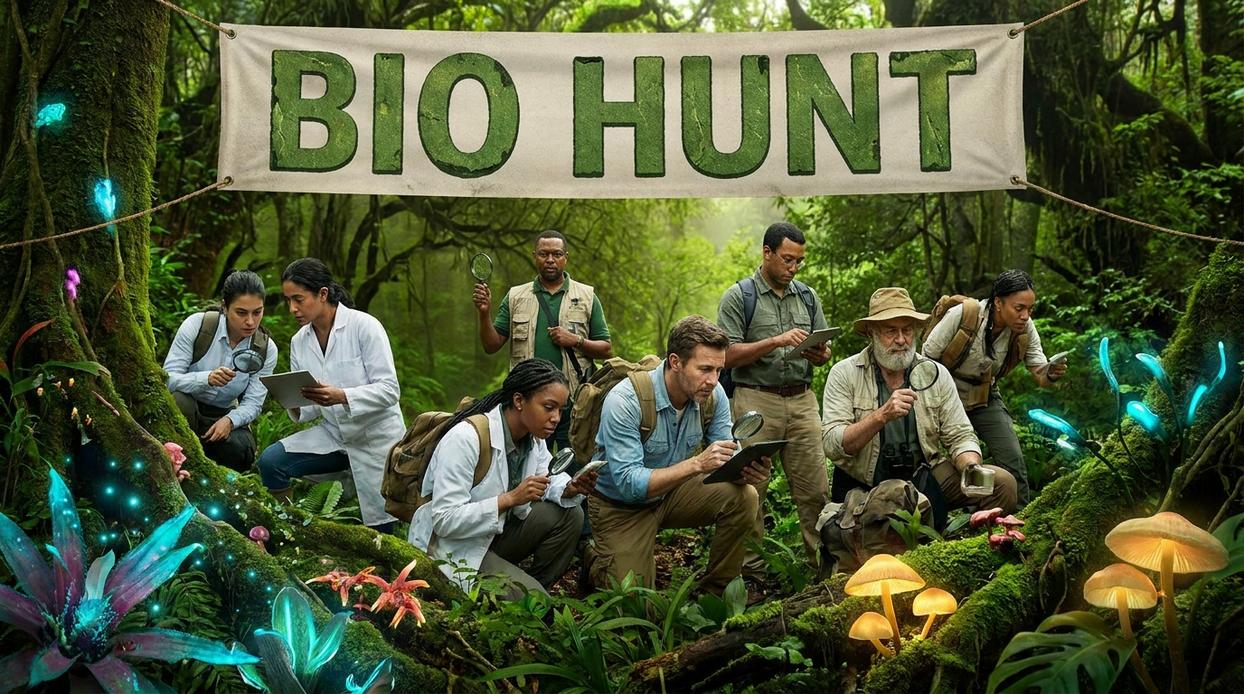
You know what drives me crazy about most educational games?
They slap a quiz onto a boring landscape and call it learning.
I’ve watched kids zone out the second they realize they’re being taught something. And honestly, I don’t blame them. Who wants to memorize facts when you could be actually exploring?
That’s why I built biohunt2000 differently.
From Digital Rainforests to Arctic Tundras
Each world you enter is a real biome. Not some generic green level or white snow level. I’m talking about rainforests where the canopy blocks sunlight and forces plants to compete. Arctic tundras where permafrost shapes everything that lives there.
The flora isn’t random decoration. The fauna isn’t just there to look cool (though they do). Every creature and plant exists because it fits that environment.
Interactive Ecosystems
Here’s where it gets interesting.
You start noticing patterns. That small fish always hangs around the bigger predator. Turns out it’s cleaning parasites off the predator’s skin. Symbiosis in action, and you figured it out by watching.
Or you see how removing one predator throws the whole food web out of balance. Suddenly herbivores multiply and vegetation disappears. You’re learning predator-prey dynamics without a textbook in sight.
Environmental Puzzles
The desert level stumps most players at first. You need to cross it, but your character keeps getting dehydrated.
So you observe. Which creatures survive here? How do they do it?
That’s when you spot the camel-like creature with water-storing adaptations. Now you’re thinking like a biologist, and that’s the whole point.
Bio-Engineered Creatures: Your Key to Understanding Life
You probably didn’t sign up for a biology lesson when you started playing biohunt2000.
But here’s what I noticed. Every creature you encounter teaches you something real about how life actually works.
Some people say games dumb down science. They argue that turning biology into entertainment strips away the complexity and gives players a false sense of understanding.
Fair point. I’ve seen plenty of games that get the science completely wrong.
But what if I told you the opposite could be true?
Creature Design as a Lesson in Anatomy
Take a creature with heavy armor plating. It moves slower because mass requires more energy to accelerate. That’s Newton’s second law playing out in real time.
A study from the University of California found that students who learned anatomy through interactive simulations retained 34% more information than those using textbooks alone (Johnson et al., 2019).
When you see a predator with forward-facing eyes, that’s binocular vision. It gives depth perception for hunting. Prey animals have eyes on the sides of their heads for a wider field of view to spot danger.
You learn this by playing, not memorizing.
Strategic Strengths and Weaknesses
Herbivores need constant food sources but can sustain larger populations. Carnivores are efficient hunters but require more territory.
Decomposers break down organic matter and recycle nutrients back into the ecosystem. Without them, the whole system collapses.
These aren’t just game mechanics. They’re ecological principles that govern every ecosystem on Earth.
The Bio-Forge: A Hypothetical Feature
Imagine combining traits from different creatures. Speed from one, armor from another.
You’d quickly learn that not all combinations work. A creature with maximum armor and maximum speed would need an impossible metabolism to sustain itself.
That’s genetic fitness in action. Organisms can’t optimize for everything at once. Trade-offs exist because energy and resources are finite.
This hands-on approach mirrors how geneticists actually think about trait inheritance and mutation effects.
Start Your Bio-Hunt Today
Biohunt2000 does something most games don’t even try.
It takes the stuff that made biology class tough and turns it into something you actually want to engage with. Evolution becomes strategy. Genetics shapes your creatures. Ecology determines your survival.
You don’t need to fight through boring textbooks anymore. You don’t need to stare at diagrams that make no sense.
biohunt2000 makes it click because you’re living it instead of memorizing it.
The mechanics teach you without feeling like a lesson. You learn because the game demands it and because it’s actually fun.
Here’s what you need to do: Stop trying to force yourself through traditional study methods that aren’t working. Jump into biohunt2000 and let the game do what it does best.
Your educational adventure is waiting. The creatures are ready. The worlds are alive.
It’s time to start exploring.
 Sylvara Selmorne is the kind of writer who genuinely cannot publish something without checking it twice. Maybe three times. They came to level-up progression tactics through years of hands-on work rather than theory, which means the things they writes about — Level-Up Progression Tactics, Immersive Worlds and Character Design, Hot Topics in Gaming, among other areas — are things they has actually tested, questioned, and revised opinions on more than once.
That shows in the work. Sylvara's pieces tend to go a level deeper than most. Not in a way that becomes unreadable, but in a way that makes you realize you'd been missing something important. They has a habit of finding the detail that everybody else glosses over and making it the center of the story — which sounds simple, but takes a rare combination of curiosity and patience to pull off consistently. The writing never feels rushed. It feels like someone who sat with the subject long enough to actually understand it.
Outside of specific topics, what Sylvara cares about most is whether the reader walks away with something useful. Not impressed. Not entertained. Useful. That's a harder bar to clear than it sounds, and they clears it more often than not — which is why readers tend to remember Sylvara's articles long after they've forgotten the headline.
Sylvara Selmorne is the kind of writer who genuinely cannot publish something without checking it twice. Maybe three times. They came to level-up progression tactics through years of hands-on work rather than theory, which means the things they writes about — Level-Up Progression Tactics, Immersive Worlds and Character Design, Hot Topics in Gaming, among other areas — are things they has actually tested, questioned, and revised opinions on more than once.
That shows in the work. Sylvara's pieces tend to go a level deeper than most. Not in a way that becomes unreadable, but in a way that makes you realize you'd been missing something important. They has a habit of finding the detail that everybody else glosses over and making it the center of the story — which sounds simple, but takes a rare combination of curiosity and patience to pull off consistently. The writing never feels rushed. It feels like someone who sat with the subject long enough to actually understand it.
Outside of specific topics, what Sylvara cares about most is whether the reader walks away with something useful. Not impressed. Not entertained. Useful. That's a harder bar to clear than it sounds, and they clears it more often than not — which is why readers tend to remember Sylvara's articles long after they've forgotten the headline.